
Practice mode
Keep the paper order while you learn, with a calmer route into the mock experience.
modeguidedOpenMock exams
A mock is useful when it keeps the board, level, order and result model honest. Both modes use the target section clocks, exam audio and end-of-paper results, while Practice mode lets you save and resume and Real exam mode treats leaving as ending the attempt.
A mock does not promise a certificate. It gives you one honest reading of the paper you selected.
Choose the mode that fits your preparation, finish the paper and review the result by skill and Teil.
Browse
Keep the paper order while you learn, with a calmer route into the mock experience.
modeguidedOpen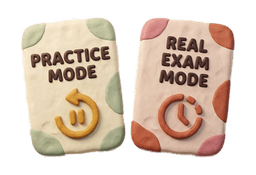
Use the paper's timing and sequence, then see the result when the mock ends.
modetimedOpen
Use the one included mock for the selected target, then decide what the result asks you to practise.
accessfirst mockOpenThe numbers
Featured
Start with the skill or Teil that pulled your result down, then return to practice mode for that exact format. A mock is a checkpoint, not a label you have to carry.
How to use it
Step 1: Pick the board and level you plan to take. A mock only tells you something when its paper shape matches the target in your head.
Step 2: Use Practice mode when you are still learning the sequence, timing and handover between parts. Save and exit when you need to, then resume the same run.
Step 3: Use Real exam mode when you need timed breaks and the exam leave rule. It keeps the same section clocks, exam audio and end-only result as Practice mode, while leaving ends the attempt after confirmation.
Step 4: Finish before you interpret the result. A partial paper cannot answer whether the selected target is ready.
Step 5: Review the result by skill and Teil. Choose one task shape for the next practice run and write down the move that will change it.
Step 6: If the target is still opening soon, use the matching skill practice page and return to the mock when that paper is ready.
Step 7: Before the run, check the small rules that affect decisions: a listening play count, a shared written block, a preparation period or a module result.
Step 8: During the run, protect your attention. Read the instruction, make a best choice and keep the paper moving so one hard item does not own the clock.
Step 9: After the run, separate accuracy from pacing. A wrong answer caused by a missed clue needs a different practice move from an answer left unfinished.
Step 10: Use the same board and level on the next focused session. A changed target can hide whether the review actually helped.
Step 11: A mock result is a dated snapshot of one sitting. Let it guide the next task without turning it into a promise about the official certificate.
Step 12: The mode choice is part of preparation. Learn the route with Practice mode, then use Real exam mode for timed breaks and the exam leave rule when the paper feels familiar.
Step 13: A mock can expose a handover problem that a skill run cannot. Notice whether the miss came from the task, the time or the change between modules.
Step 14: Keep the result tied to its target in your notes. Board and level are part of the evidence, just like the skill and Teil that changed the score.
Step 15: Book the next practice action before you take another mock. The most useful checkpoint leaves a small, visible route back into the product.
Choose your target
Cells carry the level tone and the live state. Pick one and the button keeps your board and level.
Hover or tap a cell to keep its board and level in the button.
Questions
It follows the declared board and level shape so you can practise timing and decisions. The official examining board still sets the real paper, result and certificate.
Mocks keep the result until the paper is complete. Practice runs are different: they are untimed and give feedback after each answer.
Both modes keep the target's section clocks, exam audio, module order and end-only result. Practice mode lets you save, exit, resume and take ready breaks, while Real exam mode uses timed breaks and ends the attempt when you leave after confirmation.
One mock is free for each account over its lifetime. Premium includes unlimited mocks, subject to the selected target's composition.
Use the matching skill page to practise the available task shapes. The mock selector only offers a target when its paper composition is ready today.
Sources: Sprachpass entitlement, mock-fidelity and composition contracts, exam shape registry and capability matrix.
Ready when you are
Learn the paper in Practice mode or use Real exam mode with timed breaks and the exam leave rule, then use the result to choose one next task.