Use the answer while it is fresh
After a miss, name the exact move that would have helped: wait for the correction, scan the condition, cover the task point or invite the partner's response. Then take one more item with that move in mind.
Practice the paper
Practice gives you room to learn the exact task shape before a timed paper. Choose a skill, board and level, answer original questions and use the feedback while the decision is still fresh.
Practice is the place to make mistakes with a clear next move.
Pick one skill and target, complete a short run and let the review tell you what to repeat.
After a miss, name the exact move that would have helped: wait for the correction, scan the condition, cover the task point or invite the partner's response. Then take one more item with that move in mind.
Browse

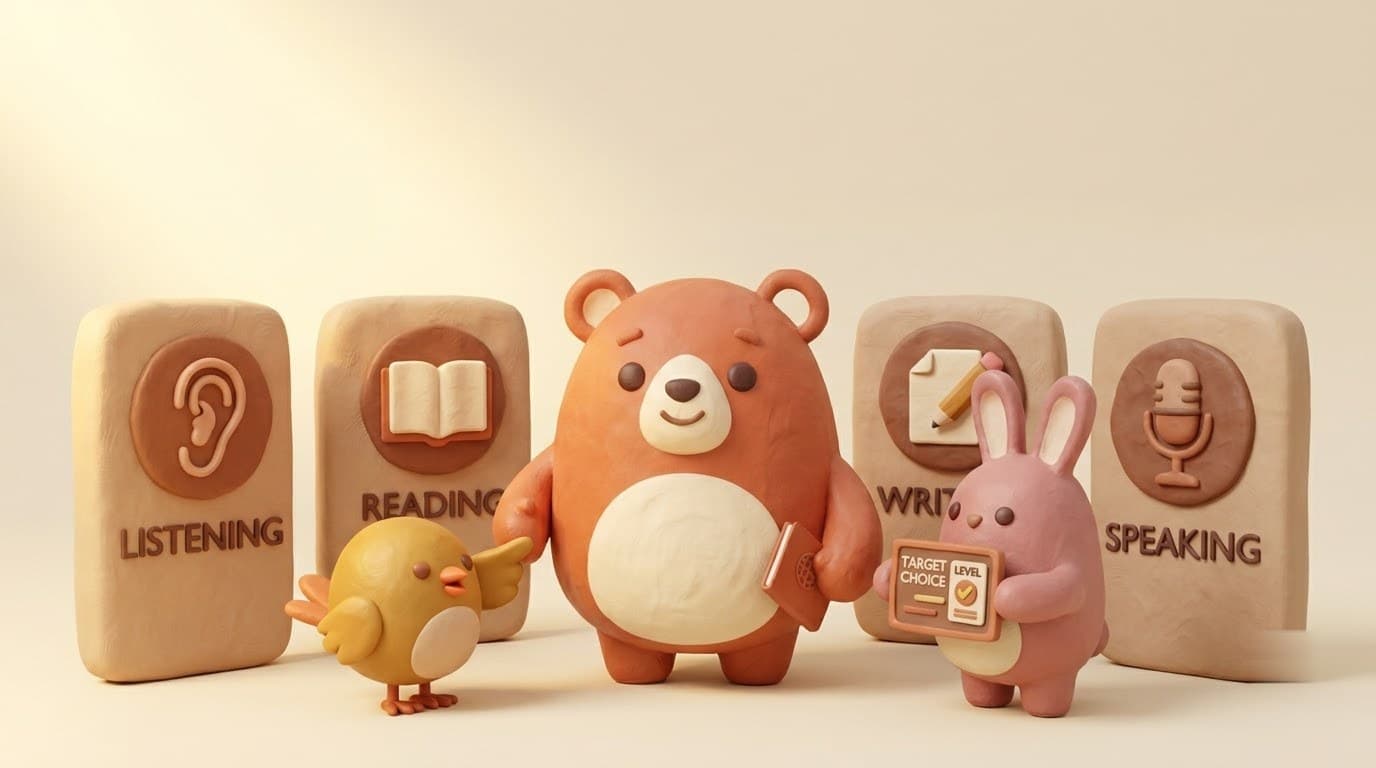
Follow the official play count and find the phrase that decides each answer.
skilllisteningOpen
Scan notices, messages, opinions and arguments for the proof behind the choice.
skillreadingOpen
Answer the brief with the right reader, register, text type and task points.
skillwritingOpenBuild a clear turn, react to a partner and repair a missing word without stopping.
skillspeakingOpenThe numbers
How to use it
Step 1: Choose the board you will take. Goethe and telc share CEFR labels but can use different parts, timings and result models.
Step 2: Choose the level you need to practise. The page keeps the target visible so an A2 task does not quietly become a B1 task.
Step 3: Choose one skill. A practice run is easier to understand when the feedback describes one exam job instead of four at once.
Step 4: Read the task before you answer. Look for the detail, relationship, text type or speaking job that can decide the item.
Step 5: Use the explanation after every answer. Keep one sentence of advice for the next item and one pattern for your next session.
Step 6: Move to a mock when you can explain the format. Practice mode is for learning; Real exam mode is for the paper's timing and order.
Step 7: For Hören, read the question before the recording and wait for the complete correction. For Lesen, point to the proof before you trust a familiar word.
Step 8: For Schreiben, check the reader and every task point before you edit language. For Sprechen, keep the exchange moving with a question, reaction or repair.
Step 9: A practice run is a small experiment. Change one move, answer the next item and see whether the explanation now makes sense.
Step 10: Use the target selector every time you change board or level. The same skill name can hide a different Teil, block or result rule.
Step 11: Stop when you have a useful pattern. More questions are less valuable when you cannot name what the next question should teach you.
Step 12: Return to the same Teil after a review note. Repetition with a changed decision is how a format becomes familiar.
Step 13: Use the skill page's format table as your warm-up. It tells you what to expect before the first item asks you to decide.
Step 14: Keep accuracy and confidence separate in your note. A lucky answer needs a proof, and a wrong answer can still reveal a useful question.
Step 15: When you finish, choose the next practice page before you leave. A result connected to an action is easier to remember tomorrow.
Choose your target
Cells carry the level tone and the live state. Pick one and the button keeps your board and level.
Hover or tap a cell to keep its board and level in the button.
Questions
Hören and Lesen use ten questions in a run. Schreiben and Sprechen use one graded task per submission, with the board and level selected first.
Yes. Use the board selector before you start a run.
The question shape, part label and feedback stay tied to the selected board and level.
Free accounts get one Hören run, one Lesen run, two Schreiben tasks and two Sprechen tasks each day. One free mock is available per account lifetime.
Use practice when you are still learning a task shape or need instant feedback. Use a mock when you want to test timing, order and the result at the end.
Premium removes the daily practice question limits and includes unlimited mocks. Writing and speaking grading use a separate monthly allowance.
Yes. Repeat the same target when you have a new move to test, then compare the explanation pattern rather than chasing a higher number alone.
Keep the target fixed.
Sources: Sprachpass practice and entitlement contracts, exam shape registry and public pages v4 content contract.
Ready when you are
Set your board and level, pick a skill and use the explanation to make the next answer easier.