
Goethe B2 for Work in Germany: Who Needs It and Why
Who actually needs Goethe B2 to work in Germany: nurses and regulated professions, what recognition authorities ask, and where B1 is enough.
Published
On this page
Short answer
You need B2 German for work in Germany when a rule or an employer names it, and the biggest group named is nurses: the official Make it in Germany portal requires at least CEFR level B2 for the professional recognition of internationally trained nurses. An Ausbildung visa normally asks for B1, and most non-regulated jobs set no legal language level at all. So check who is asking, the recognition authority, the visa rules or the job ad, and prepare for the level on that list.
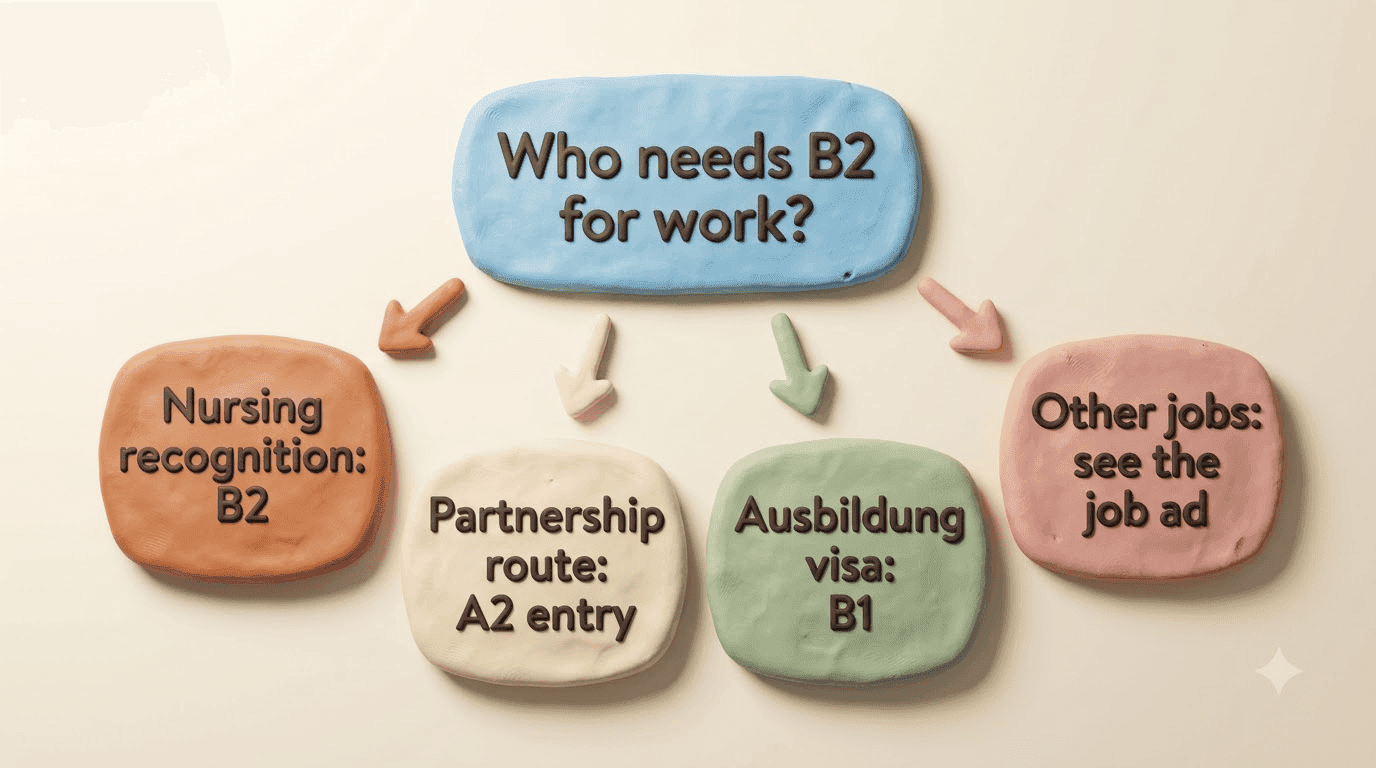
B2 is a gate for specific paths, not a general law
Germany sets no single language level that covers every foreign worker; the requirements live in specific gates, and B2 guards the most important one: professional recognition in nursing. The rule is plain: for recognition, you must have at least level B2 according to the CEFR. Recognition is what converts a foreign nursing qualification into a German licence, so for internationally trained nurses B2 is the line between assistant work and practising the profession.
| Path | German level named | Who sets and accepts it |
|---|---|---|
| Nursing recognition (trained abroad) | At least B2 (CEFR) | Recognition authority of the federal state; procedure listed on the official Recognition in Germany portal |
| Recognition partnership (work first, recognise after arrival) | A2 minimum for the visa; a higher level can be required depending on the profession, and nursing recognition still requires B2 | German mission for the visa; recognition authority for the licence |
| Ausbildung (vocational training) visa | Normally B1 | German mission under the visa rules; schools and employers may ask higher |
| Non-regulated jobs (IT, logistics, hospitality and most others) | No legal level; job ads often name B1 or B2 | The employer |
The nurse pipeline: two ways to reach the same B2
The classic route is recognition first: German to B2 in your home country, exam, then the recognition file to the competent authority, whose requirements per federal state are listed on the official Recognition in Germany portal. It is slower before departure but you arrive with a licence in reach.
The newer route is the recognition partnership: you enter with a contract and German at A2, the visa's minimum on the official recognition-partnership page, which adds that a higher level can be required depending on the profession. A nurse on this route works in a support role first and still has to reach B2 to complete recognition. The separate Ausbildung visa's normal B1 requirement is on the official training-visa page. Either way the destination is the same certificate; the routes only move where you study for it.
What the B2 exam itself asks of you
The Goethe-Zertifikat B2 is modular: reading, listening, writing and speaking are four independent modules, each scored out of 100 and passed at 60, and each can be retaken on its own. That structure suits working adults, because a lower result in one module never costs the other three. The complete format and timings are in the Goethe B2 exam guide, and if you are still weighing boards, the trade-offs are laid out in Goethe vs telc: which German exam should you take?.
Do not underestimate the jump from B1. B2 texts argue rather than describe, half the listening plays only once, and the writing module expects a structured opinion piece. Employers ask for B2 precisely because it is the level where German stops being survival and starts being work.
Planning B2 around a job, not around a course
Most people preparing B2 for work are already working, which makes the modular structure useful. The four modules are independent, so a lower result in one does not remove the three you passed.
Budget time honestly for the climb itself. B1 to B2 is typically the longest single-level jump learners experience, months of consistent work rather than weeks, because the exam stops rewarding memorised patterns and starts rewarding opinions you can defend. If your employer or authority has a fixed deadline, use it to decide how many hours per week the plan needs.
Fees, dates and centres change; BookGermanTest keeps the live list (opens in a new tab).
Check the list, then commit
The rule that survives every case in this article: the requirement lives in a list someone publishes, the recognition authority's, the visa rules or the job advertisement, and that list beats any general statement, including ours. Read it first, confirm which certificates it accepts, then point your preparation at exactly that level. More B2 guides are collected in the Goethe B2 preparation topic.
Questions people ask
Do nurses need B2 German to work in Germany?
For full professional recognition, yes: the official Make it in Germany portal states that internationally trained nurses must have at least level B2 of the CEFR for recognition. The competent recognition authority of the federal state runs the procedure and states exactly which certificates it accepts.
Is B1 or B2 required for an Ausbildung in Germany?
For the Ausbildung visa you will normally need German at level B1 under the official visa requirements. Many employers and vocational schools ask for more in practice, especially in healthcare, so the level in your specific contract and school admission is the one that counts.
Does every job in Germany require a B2 certificate?
No. There is no single language level that every job in Germany requires; levels are set per profession, per visa route and per employer. B2 is a formal requirement mainly in regulated professions such as nursing, and a practical requirement wherever employers name it in the job advertisement. Always check the specific employer or authority list.
Which B2 exam should I take for work in Germany, Goethe or telc?
Both boards certify CEFR B2 and both are widely known German exam providers. What matters is that the body asking for B2, a recognition authority or employer, accepts your certificate, so confirm against their published list before booking either exam.
Keep reading
Is telc Accepted for German Visas? What Offices Accept
Is telc accepted for German visas? India's embassy list names telc for joining a husband, wife or partner. See the level each visa asks for.
Read articletelc B2 for Nurses: The Path to Anerkennung
Nurses need B2 German for Anerkennung, when Germany accepts nursing training from abroad. See where telc fits from A2 to B2, and its nursing exam.
Read articleHow Hard Is telc A1? An Honest Difficulty Guide
How hard telc A1 really is, skill by skill: what the 60-point exam asks, where candidates lose points, and why the pass mark of 36 is reachable.
Read articleGoethe B2
Practice this on Sprachpass
Review the full exam guide, then practise the task types for the exam in front of you.