
telc B2 for Nurses: The Path to Anerkennung
Nurses need B2 German for Anerkennung, when Germany accepts nursing training from abroad. See where telc fits from A2 to B2, and its nursing exam.
Published
On this page
Short answer
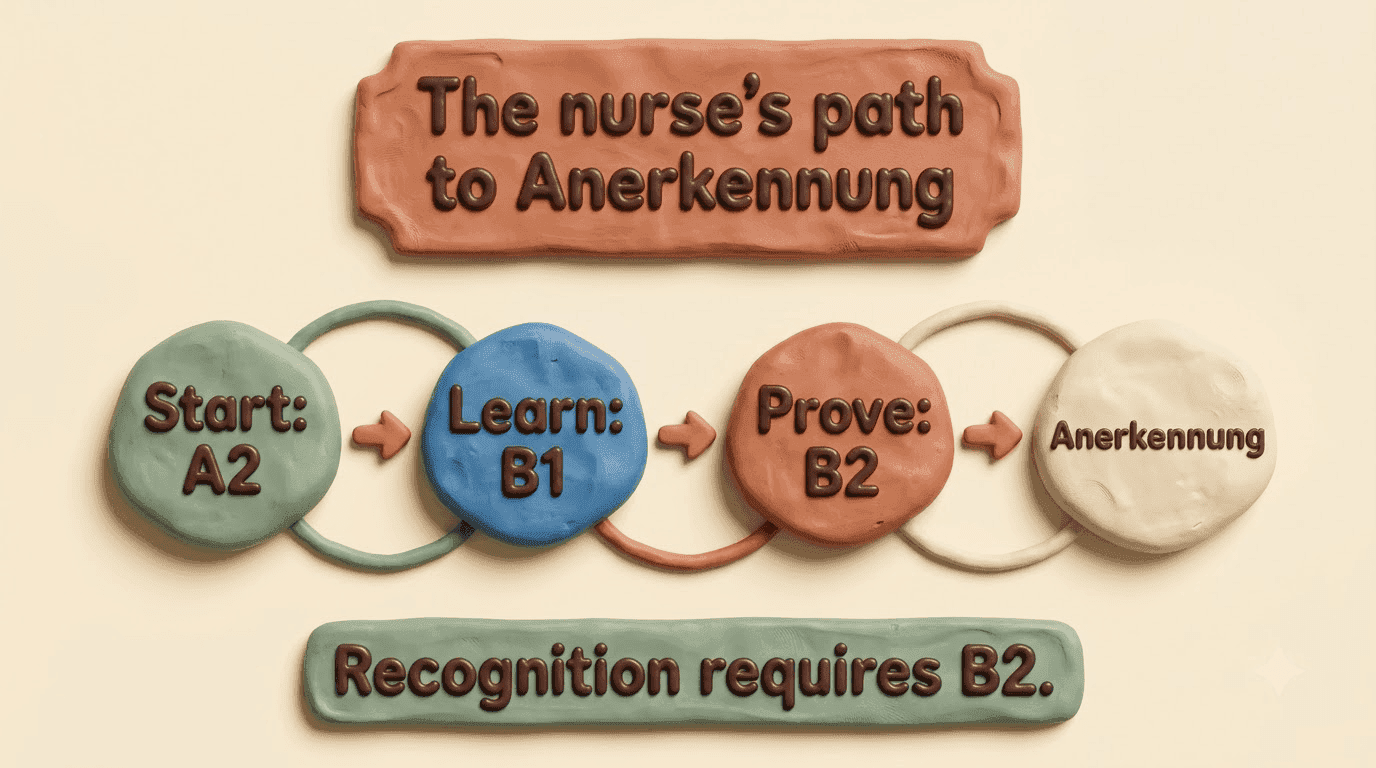
Nurses need German at level B2 for Anerkennung in Germany, and telc B2 is one way to show it if the recognition office accepts it. Anerkennung is the official recognition of a nursing qualification from another country. Make it in Germany (the German government's website for people who move to Germany to work or train) says this B2 rule clearly. The recognition office in your German state decides which certificate it accepts. telc has two exams for this: the general telc Deutsch B2, and telc Deutsch B1-B2 Pflege, an exam built on nursing texts and tasks (Pflege means nursing care). One official route works like this: reach A2 at home, come to Germany through a recognition partnership (a job contract with an employer who takes part in this special route), and then learn up to B2 while your recognition papers are being checked.
Why B2 is the level that matters
Germany actively looks for nurses, and the language rule at the end of the path does not change. The official Make it in Germany website says that for recognition you need at least level B2 on the CEFR, the European scale of language levels. The rule exists because nursing needs exact language: passing on patient news to the next shift, writing patient records, explaining medicine, and talking with patients and their families. So you must reach B2 in the end, whatever level you start from. The recognition office in your German state decides which certificate proves that level. That means your first step is not to book an exam. It is to read that office's list of documents. The same is true for visas: the visa office decides which language proof it accepts.
| Step | German level | What the official guidance says |
|---|---|---|
| Getting your nursing training checked | no level named for this step | Germany must recognise your nursing training. One way: an office checks your training papers to see if they match German training. The other way: you skip that check and go straight into an adaptation course, which is extra training for the parts your first training did not cover |
| Coming to Germany through a recognition partnership | A2 | A2 is the language level for this route. You need a German job contract, an employer who takes part in the partnership, and a nursing qualification recognised in the country where you earned it |
| Getting ready and arriving | working toward B1 | In Triple Win partner countries, India among them, GIZ organises German courses up to B1 in your home country and helps nurses with the German offices after they arrive. Triple Win is a programme that brings nurses to Germany, run by the German Federal Employment Agency and GIZ, a German government-owned agency |
| Official recognition (Anerkennung) | B2 | At least B2 on the CEFR is needed for recognition; the recognition office in your German state decides which certificate it accepts |
Where telc fits on the path
telc has two exams that matter here. The general telc Deutsch B2 shows B2 German for daily life and work. It has a written exam with reading, Sprachbausteine (a grammar section), listening and writing, plus a spoken exam. It is scored out of 300 points, and you need a minimum score in both the written and the spoken part. The special telc Deutsch B1-B2 Pflege was made for exactly this group. It shows your level across B1 and B2. Its reading and listening texts come from a nurse's normal working day, and its writing includes a report task like the reports nurses write at work. telc gives a free practice exam and tips for the Pflege exam, so you can study the format before you pay for anything.
Do not choose by what you like. Choose by what your office accepts. Recognition offices and employers say which certificates they accept, and the same certificate can be on one German state's list and missing from another state's list. Ask before you book. If the answer will decide months of study, ask for it in writing.
Planning your way from A2 to B2
Going from A2 to B2 is the biggest piece of work on this path. It needs a real plan, not just hope. Plan B1 as a full step and give it enough time. The grammar and words that B2 tests build on what you learn at B1, and nursing German also has its own words. Nurses who study while working shifts do better with short daily sessions than with a few long weekends of study: for example, listening practice on the way to work and one writing task a week in exam format. The B2 exam formats are public, so from the halfway point on, practise in the real exam format. Before exam day, know the task types, the timing and how the pass marks work. Start with the telc B2 exam guide.
The checks that save months
Do three checks early to keep your plan on time. First, ask the recognition office in the German state where you want to work which language certificates it accepts: general B2, the Pflege exam, or both. Second, if you have an employer, ask if a recognition partnership applies to you. The Make it in Germany website sets its language level at A2, which changes how soon you can move to Germany. Third, compare the exam formats of telc and the Goethe-Institut. Goethe B2 for work in Germany explains the difference. Fees, dates and centres change; BookGermanTest keeps the live list (opens in a new tab). More telc B2 guides, on formats and how to prepare, are in the telc B2 preparation topic.
Questions people ask
Which German level do nurses need for recognition in Germany?
At least B2. Anerkennung is the German word for the official recognition of a nursing qualification from another country. The official Make it in Germany website says that for Anerkennung you need at least level B2 on the CEFR, the European scale of language levels that goes from A1 (beginner) to C2 (very advanced). The recognition office in your German state that handles your papers decides which certificate it accepts. So check its list of documents before you book an exam.
Can a nurse start in Germany with less than B2?
Yes, on some special routes. One of them, described on the Make it in Germany website, is a recognition partnership. On this route you come to Germany to work first and finish your recognition (Germany officially accepting your nursing training) there. You need a German job contract, an employer who takes part in the partnership, and a nursing qualification that is officially recognised in the country where you earned it. Then you can come with German at A2 and finish your recognition in Germany. You still need B2 for full recognition as a nurse, so you keep learning German after you arrive.
What is telc Deutsch B1-B2 Pflege?
Pflege is the German word for nursing care. telc Deutsch B1-B2 Pflege is a telc exam made for nurses. It tests German from B1 up to B2 in reading, listening, writing and speaking. Its texts and tasks come from nursing work. One writing task is a report, like the reports nurses write at work. telc gives a free practice exam and tips to help you get ready for it.
Should a nurse take general telc B2 or telc Deutsch B1-B2 Pflege?
It depends on what your recognition office and your employer ask for. The general telc B2 shows B2 German for daily life and work. The Pflege exam (Pflege means nursing care) shows German for nursing work, across B1 and B2. Before you book either one, ask the office handling your Anerkennung (your official recognition as a nurse) which certificates it accepts. Then follow its answer.
Keep reading
Is telc Accepted for German Visas? What Offices Accept
Is telc accepted for German visas? India's embassy list names telc for joining a husband, wife or partner. See the level each visa asks for.
Read articleHow Hard Is telc A1? An Honest Difficulty Guide
How hard telc A1 really is, skill by skill: what the 60-point exam asks, where candidates lose points, and why the pass mark of 36 is reachable.
Read articleGoethe B1 Modules: Retake Only What You Failed
How the Goethe B1 module system works: four independent modules, pass at 60 each, and how to retake only the module you failed.
Read articletelc B2
Practice this on Sprachpass
Review the full exam guide, then practise the task types for the exam in front of you.