Can You Take Goethe B1 Directly? Yes, Here Is How
You can register for Goethe B1 without passing A1 or A2 first: the official rule, what direct entry really demands, and how to know you are ready.
Published
On this page
Short answer
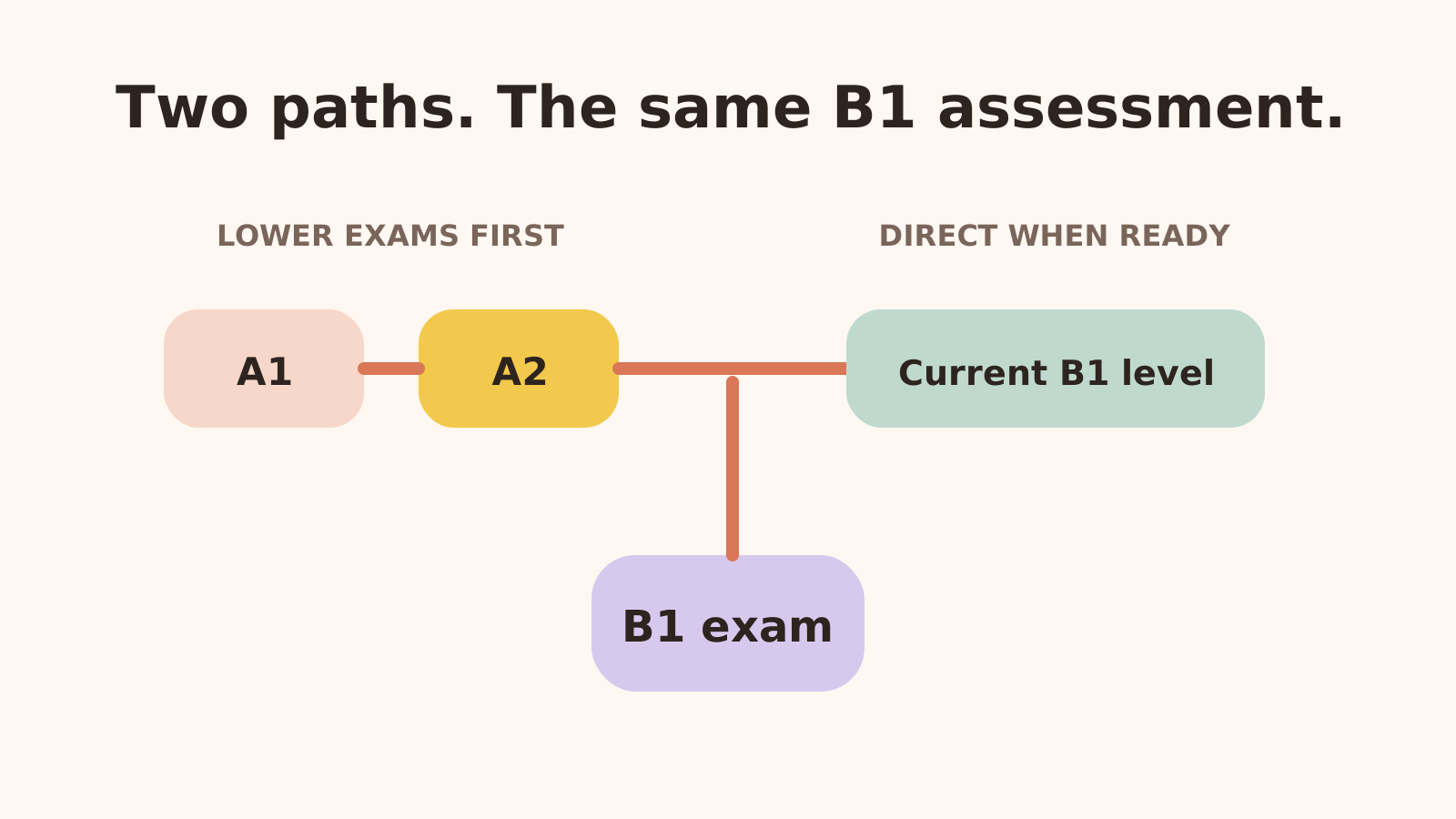
Yes. You can register for Goethe B1 directly, without ever having taken A1 or A2. The Goethe-Institut's official requirement text says its exams are "generally open to anyone and can be taken regardless of age or nationality"; the lower certificates are not a precondition. What direct entry really demands is a true B1 in all four skills, because each of the four B1 modules has its own pass mark of 60 out of 100 and no module can carry another.
The rule
The question comes up constantly because it feels too good to be true: surely a B1 exam requires proof you passed the levels below? It does not. The official Goethe B1 page puts the whole eligibility rule in one sentence: the exams are open to anyone, regardless of age or nationality, with only a recommended age of 16 and up for the adult exam. Registration asks for your identity, not for an A2 certificate.
The same principle applies across boards: telc likewise offers its exams by level, and the official telc B1 exam page lists no lower certificate among its conditions. German exams certify a level; they do not gate the ladder.
| Rule | Goethe | telc |
|---|---|---|
| Previous certificate required? | No; exams are open to anyone regardless of age or nationality | None listed on the official telc B1 page |
| What you must prove | Your German is tested on the day | Your German is tested on the day |
| Structure at B1 | 4 independent modules, 100 points each, pass at 60 per module | One qualification: a written examination plus an oral pair examination |
| Partial booking | Yes: single modules | Not offered as separate modules |
Why direct entry is often the rational choice
The bookings. If your goal requires B1, direct entry avoids separate A1 and A2 exam sittings. Fees, dates and centres change; BookGermanTest keeps the live list (opens in a new tab).
The time. If your goal, an Ausbildung place, a job, naturalisation, names B1, the lower certificates rarely matter afterwards; what any given programme requires is decided by its own document list, which is why you check that list first.
The modules. Goethe B1's modular structure softens direct entry's main risk. Because reading, listening, writing and speaking are certified independently, you retake only the module you failed. The full structure is in the Goethe B1 exam guide, and the module retake guide explains how separate results change the preparation plan.
The honest catch: B1 means B1 everywhere
Direct entry removes the bureaucratic ladder, not the linguistic one. The B1 exam assumes everything A1 and A2 taught, and its pass rule is unforgiving in one specific way: 60 of 100 in every single module. A candidate with B1 reading and A2 speaking does not get a B1 certificate; they get three module certificates and one retake to organise.
Self-taught candidates often carry exactly that profile, strong reading and listening, weaker writing and speaking, since reading and listening grow from consuming German while writing and speaking need practice with feedback. If that is you, direct B1 is still sensible; just aim your remaining preparation at the output modules.
Does a B1 certificate cover requirements that name A1?
Usually, yes, because most requirements are worded as a minimum. The German missions in India, for example, ask spouse-visa applicants for a certificate "at least at level A1", which a B1 certificate satisfies. So a learner whose long-term goal is B1 does not need to detour through A1 for the visa either; one exam can serve both purposes. The caveat is the word "usually": when a specific programme, employer or authority names its accepted certificates, its list is the rule, so confirm against your actual requirement before deciding which single exam to sit.
How to know you are ready
- Test all four skills in exam format, separately. The module pass marks make per-skill readiness the only readiness that counts. Format-exact practice with feedback shows each skill against the 60-point line.
- Score above the pass line consistently, not once. One good run is luck; five in a row is a level.
- Consider staging the modules. Taking your two strongest modules first can bank those results and give you more preparation time for the weaker two.
- Sit one full timed mock before the real day. Direct entrants have never felt a German exam's clock; do not let the B1 exam be your first.
Skipping A1 and A2 is not a shortcut through the German language; it is a decision to be tested at the level you actually need. Made with evidence, it can avoid unnecessary sittings. More B1 guides are collected in the Goethe B1 preparation topic.
Questions people ask
Do I need an A1 or A2 certificate to take Goethe B1?
No. The Goethe-Institut states its exams are generally open to anyone, regardless of age or nationality. No previous certificate is asked for at registration; you simply book the B1 exam and pay the fee.
Can taking B1 directly avoid earlier exam bookings?
Yes. If your goal requires B1 and you are ready at that level, direct entry can avoid separate A1 and A2 exam sittings. Readiness matters more than the number of certificates you collect on the way.
Can I take just one B1 module directly?
Yes. Goethe B1 is modular: reading, listening, writing and speaking can be booked and certified separately. Some candidates enter with the modules they are strongest in and add the rest later.
What level of German do I actually need for direct B1?
A genuine B1 in all four skills: each module has its own pass mark of 60 out of 100, so strength in reading cannot compensate a weak speaking module. Score consistently above the pass line in format-exact practice before you book.
Keep reading
Goethe B1 Modules: Retake Only What You Failed
How the Goethe B1 module system works: four independent modules, pass at 60 each, and how to retake only the module you failed.
Read articleIs telc Accepted for German Visas? What Offices Accept
Is telc accepted for German visas? India's embassy list names telc for joining a husband, wife or partner. See the level each visa asks for.
Read articletelc B2 for Nurses: The Path to Anerkennung
Nurses need B2 German for Anerkennung, when Germany accepts nursing training from abroad. See where telc fits from A2 to B2, and its nursing exam.
Read articleGoethe B1
Practice this on Sprachpass
Review the full exam guide, then practise the task types for the exam in front of you.