Goethe A2 Practice Test: How to Use One Properly
How to use a Goethe A2 practice test properly: the official Modellsatz, a practice loop that fixes mistakes, and the scores to hit before you book.
Published
On this page
Short answer
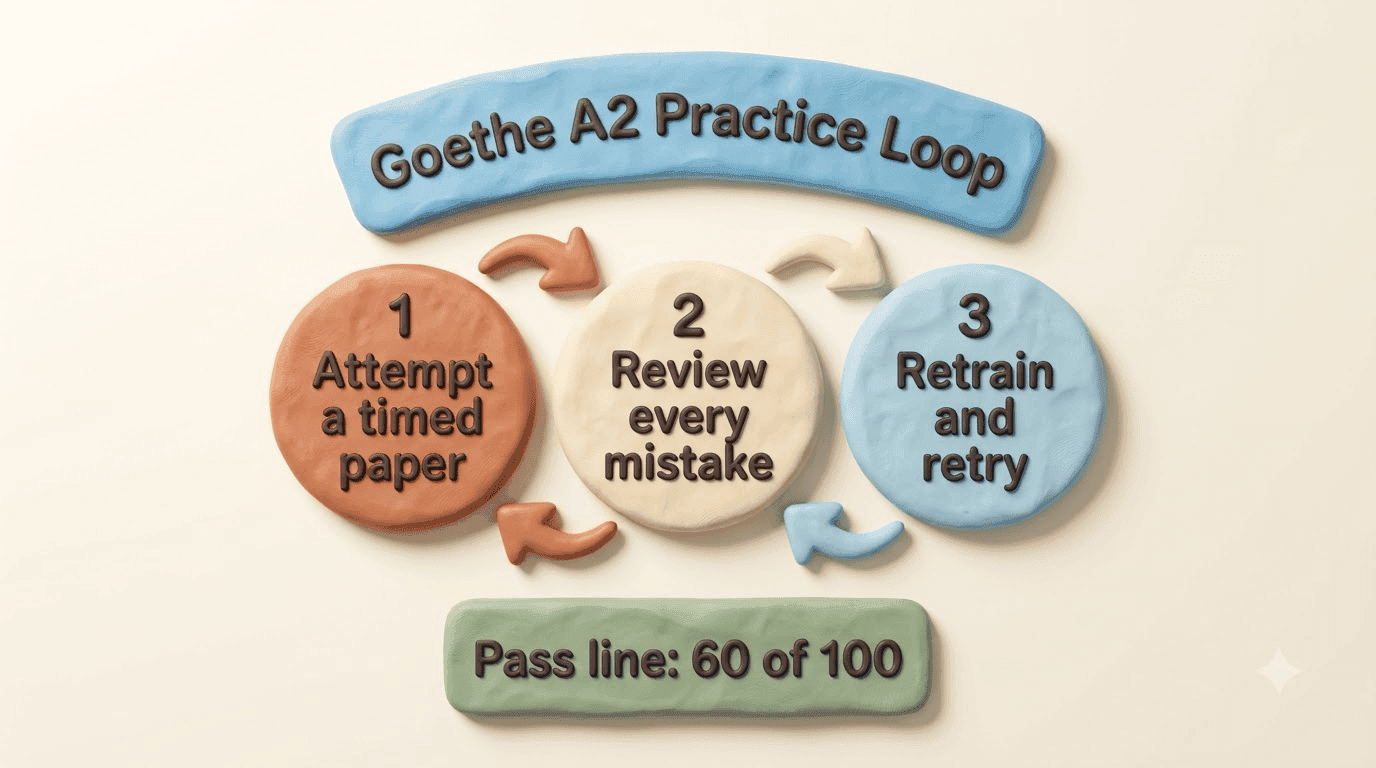
A Goethe A2 practice test is only useful inside a loop: sit the paper under real timing, review every mistake until you can say why the right answer wins, train the task type that failed, then retry. The official A2 Modellsatz gives you the exact format, 40 reading and listening questions plus two writing tasks and three speaking parts in about 105 minutes, and the pass line is 60 of 100 points, with at least 45 of the 75 written points and 15 of the 25 speaking points. Book the real exam when practice sits comfortably above that line, not on it.
Start with the official paper
Every Goethe exam has a published model version, and A2 is no exception. The official A2 Modellsatz (model exam) is a complete real paper: all four skills, the answer keys, the audio and the scoring sheets examiners actually use. The Goethe-Institut lists it with its other free practice material, and the full exam format and timing are in the Goethe A2 exam guide.
The format it shows you is fixed: reading 30 minutes, listening about 30, writing 30, and a paired speaking exam of about 15 minutes. That predictability is the entire reason practice tests work at this level. The content changes every sitting; the task shapes never do.
| Skill | Points in the exam | Practice score before booking |
|---|---|---|
| Lesen (reading) | 25 | 19 or more, consistently |
| Hören (listening) | 25 | 19 or more, consistently |
| Schreiben (writing) | 25 | 19 or more, consistently |
| Sprechen (speaking) | 25 | 19 or more, and never under 15 |
| Whole exam | 100, pass at 60 (min 45 written, 15 speaking) | around 75 or more in total |
The loop: attempt, review, retry
Most learners use practice tests backwards. They sit paper after paper, watch the score wobble around the same number, and conclude they need more papers. The score only tells you where you stand. The work happens between papers.
Attempt means real conditions: the printed timing per module, no dictionary, no pausing the audio. An untimed practice run measures your German; only a timed one measures your exam.
Review is the step that separates preparation from repetition. For every wrong answer, and every right answer you guessed, write down two things: what the correct answer was, and which words in the text or audio prove it. At A2 the proof is always there, usually one sentence. If you cannot point at it, the question goes in your retry pile even if you scored the point.
Retry targets the task type, not the whole paper. Ten extra reading matching tasks beat one extra full paper when matching is what failed. Then, after the weak types recover, sit the next full paper and let the score confirm it.
Reading the score honestly
The numbers in the table above are preparation targets, not official pass rules. The exam passes at 60 of 100, with floors of 45 written and 15 speaking points, but reaching exactly 60 percent in practice gives you little margin for nerves, unfamiliar voices in the audio or a stranger as your speaking partner.
Aim for the high seventies in practice instead, and weight the skills honestly. Receptive scores travel well from practice to exam day. Writing and speaking travel worst, because at home nobody times your letter or interrupts your monologue, which is why the A2 letter formats and the speaking card formats deserve dedicated format practice rather than an occasional appearance at the end of a full paper.
Use the model paper's extras, not just its questions
The Modellsatz ships more than questions, and the extras are exactly what self-learners tend to skip. The answer keys let you score receptive skills exactly; use them, not your feeling, because feelings systematically overrate listening. The audio files carry the real exam's pacing, pauses and instruction announcements in German, so running them without touching the pause button trains the discipline the exam room will demand. And the scoring sheets for writing and speaking show the criteria examiners mark against, task fulfilment and language quality separately, which tells you that a complete, plain answer usually beats an ambitious, broken one.
One warning about reusing the same model paper: the second attempt at identical content measures your memory, not your German. Score a repeated paper for speed and timing only, and get fresh content for real measurements, either further official material or exam-format practice with new questions each run.
When the loop says book
Stop practising when three signals line up: two consecutive timed papers above 75, no skill under 19, and reviews that mostly confirm rather than surprise. Waiting past that point buys little; A2 scores plateau quickly once the formats are automatic. More guides for this level are collected in the Goethe A2 preparation topic.
Questions people ask
Where do I find an official Goethe A2 practice test?
The Goethe-Institut publishes free practice material for every level on its practice pages, including the A2 Modellsatz, a complete model exam with answer keys, audio and the examiner scoring sheet. That paper is the format your real exam will follow.
How many practice tests do I need before the real Goethe A2 exam?
Quality beats count. One full timed paper tells you your level; what raises it is the loop between papers: reviewing every mistake, training the weak task type, then retrying. Most learners get more from three well-reviewed runs than from ten unreviewed ones.
What score in practice means I am ready to book Goethe A2?
The exam passes at 60 of 100 points, requiring at least 45 of the 75 written points and 15 of the 25 speaking points. Exam day usually costs a few points through nerves and time pressure, so a comfortable margin in practice, around 75 to 80 percent per skill, is the sensible booking threshold.
Is a practice test the same as the real Goethe A2 exam?
The task types, timing and scoring match the real exam because Goethe publishes the format. What differs is the content, which changes every sitting, and the setting: a real exam room, strict timing and an examiner pair for speaking.
Keep reading
Goethe A2 Hören: How to Train for Each Teil
The Goethe A2 listening module Teil by Teil: short texts, the week dialog, everyday conversations and the interview, with plays, items and training drills.
Read articleIs telc Accepted for German Visas? What Offices Accept
Is telc accepted for German visas? India's embassy list names telc for joining a husband, wife or partner. See the level each visa asks for.
Read articletelc B2 for Nurses: The Path to Anerkennung
Nurses need B2 German for Anerkennung, when Germany accepts nursing training from abroad. See where telc fits from A2 to B2, and its nursing exam.
Read articleGoethe A2
Practice this on Sprachpass
Review the full exam guide, then practise the task types for the exam in front of you.